


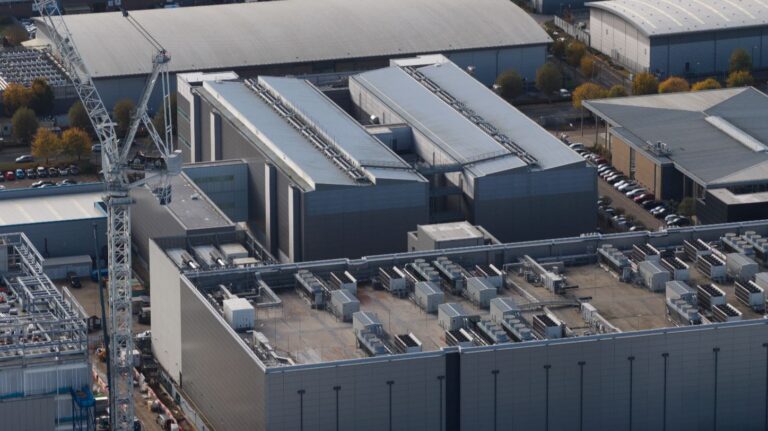
Rapid growth in data centres, artificial intelligence (AI) and quantum computing is expected to place increasing pressure on critical mineral supply chains, according to new government-backed research from the UK Critical Minerals Intelligence Centre (CMIC).
The report warns that expanding the UK’s digital infrastructure will increase demand for copper, aluminium, rare earth elements and cobalt, while quantum technologies will require critical minerals such as niobium, hafnium, bismuth, high-purity silicon and helium.
More than 90 new data centres are planned in the UK by 2030, with the government estimating that up to 6GW of AI-capable data centre capacity could be required by the end of the decade.
The expansion could have significant implications for battery supply chains.
CMIC, which is hosted by the British Geological Survey (BGS) and funded by the Department for Business, Innovation, Science & Technology, warned that supply chains for many of the materials are concentrated in a small number of countries. Additionally, some critical minerals are produced as by-products of mining and refining other commodities. Both of these factors can limit the ability of supply to respond rapidly to rising demand and increase exposure to geopolitical disruption.
Dr Holly Elliott, BGS minerals geoscientist and lead author of the report, said: “Whilst the UK has the potential to develop domestic supplies of certain critical minerals, it is unlikely to achieve self-reliance and cannot become a specialist in all parts of the supply chain.
“Access to global supply chains, international collaboration and strategic partnerships therefore remain vital; the opportunity best lies in collaboration and strategic partnerships to offset the risk posed by geopolitical uncertainty.”
The report identifies potential opportunities to develop UK supplies of lithium in Cornwall, tungsten in Devon, graphite in Northern Ireland and nickel, vanadium and platinum group metals in Scotland.
It also recommends expanding domestic processing and manufacturing capabilities, developing recycling and secondary supply chains and improving supply chain mapping and visibility of future material requirements.
Elliott added: “Geologically speaking, the Earth is not short of minerals. Scarcity is typically driven by a combination of factors, such as geopolitical access, the economic viability of extraction, and the technological constraints around our ability to refine and process them.
“History suggests that restricted supply but increasing demand creates market opportunities and that supply chains eventually catch up with demand but, in the case of minerals, this can take decades.”
The Supply Chain Excellence Awards celebrate the organisations, teams and projects driving improvement across supply chains. Tables are now available to book for the awards ceremony on 5 November at The Great Room, Grosvenor House.