

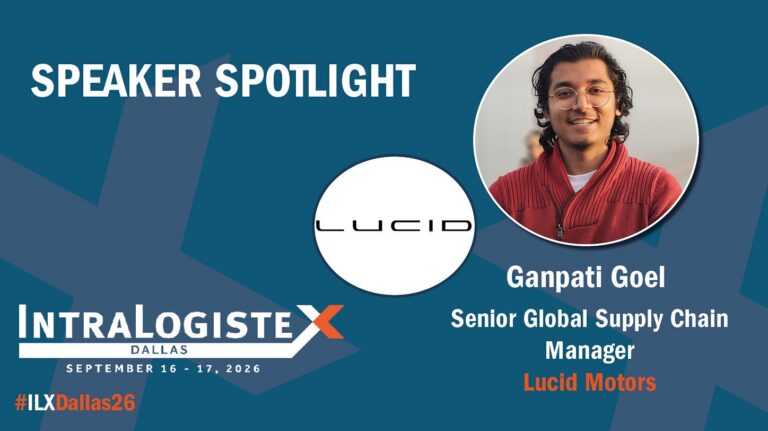
During his session at IntraLogisteX Dallas, Ganpati Goel, senior global supply chain manager at Lucid Motors, will use a real-world tariff shock to demonstrate why procurement teams need to move beyond crisis management.
His presentation, ‘From Tariff Shock to Strategic Advantage’, on 16 September is based around a supplier message he received at 6:47am on the morning a major tariff announcement was made. Using lessons from the weeks that followed, he will examine how procurement teams can build proactive supplier risk programs, make better sourcing decisions and manage complex multi-country EV supply chains without losing visibility.
FREE: Register for IntraLogisteX Dallas on 16-17 September 2026
Taking place at the Kay Bailey Hutchison Convention Center on 16-17 September, IntraLogisteX Dallas will bring together logistics and supply chain professionals to explore the latest innovations in warehousing, automation, robotics, materials handling and supply chain technology.
Ahead of the event, Logistics Manager caught up with Goel to discuss tariff shocks, supplier risk, AI and why visibility beyond Tier 1 suppliers is becoming increasingly important.
Please tell us a little about your role and organization…
I lead global supply chain sourcing strategy for Lucid Motors, an EV manufacturer, with prior roles in propulsion sourcing at Tesla and at Zero Motorcycles. My work sits at the intersection of procurement, capital planning and risk – building the frameworks that decide which suppliers we qualify, where we hold buffer, and how we price in geopolitical exposure before it shows up on an invoice. I also publish peer-reviewed research on AI-driven supplier evaluation and should-cost modeling, which feeds directly back into how we run sourcing day to day.
What will you be discussing at IntraLogisteX Dallas?
My session, ‘From Tariff Shock to Strategic Advantage’, is built around a real moment: a supplier messaged me at 6:47am the morning a major tariff shift landed, before I’d even seen the news myself. I unpack three lessons from the two weeks that followed — continuous supplier risk scoring instead of crisis response, a hard framework for choosing between buffer stock, air freight and accelerated qualification, and why dual sourcing has to be triggered by a risk threshold, not by a crisis you’re already living through.
Why is this topic particularly important right now?
Tariff shocks aren’t rare events anymore. They arrive in seasons, the way allergies do. An industry survey run annually by AMS and ABB has had supply chain disruption ranked among manufacturers’ top two challenges every year since 2022, and this year it outranked cost.
Most sourcing strategies were built for a world of frictionless borders. That world isn’t coming back. Waiting for the next shock to build resilience means you’re always negotiating from the floor of a war room instead of from a plan you wrote in peacetime.
What is the biggest challenge you see logistics and supply chain professionals facing over the next 12 months?
Visibility that stops at Tier 1. Most organisations know their direct suppliers well and their suppliers’ suppliers barely at all. So, when a tariff lands by country of origin, teams discover their actual exposure live, in real time, instead of in advance. The challenge isn’t a lack of effort; procurement teams are heroic under pressure. It’s that heroics are what you need when your systems have already failed. The fix has to start further upstream than most risk programmes currently reach.
What do you see as the biggest opportunity for procurement leaders to become more proactive in managing supplier risk?
Replacing annual board decks with a living risk score – a number that moves weekly for every supplier, covering geographic concentration, financial health, single-source exposure and tariff exposure by origin. The opportunity is treating that score as a trigger, not a report: when it crosses a threshold, second-source qualification starts automatically. Qualifying a serious EV component takes 9-12 months end to end. If a crisis is what starts that clock, the math has already beaten you.
What role do AI, data and supplier intelligence play in helping organisations anticipate supply chain risks?
I’d push back gently on the hype here. What AI actually contributes isn’t magic, it’s stamina. A category manager can meaningfully track maybe a dozen suppliers. A well-built model can watch thousands of signals every day – customs filings, financial data, shipping patterns, even local news from a sub-supplier’s factory town – without ever getting tired or bored. In practice, that kind of monitoring can flag a deteriorating supplier 9-12 months before a disruption goes public. That’s useful because qualifying a new supplier takes about the same 9-12 months. Spot it early, and you’ve already closed the gap.
What are you most looking forward to at IntraLogisteX Dallas?
Comparing notes with people who’ve lived through the same tariff shocks from different seats in the supply chain — 3PLs, carriers and other OEMs. Everyone in this space has their own version of the 6:47am phone call. I’m looking forward to hearing how other teams built their smoke detectors, and probably stealing a few ideas for mine.
IntraLogisteX is taking place in Dallas in 2026, bringing the industry’s leading trade show & conference to one of North America’s most important logistics hubs.