


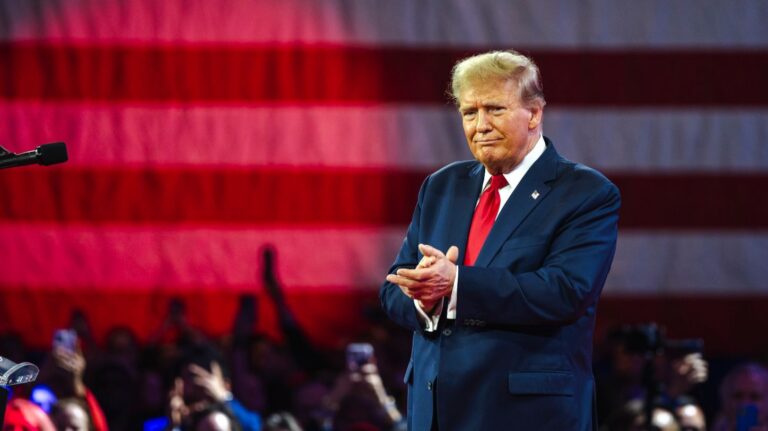
US president Donald Trump has threatened to impose trade tariffs against a host of countries that the US has deemed to have allegedly not prevented the import of goods made by forced labour.
The threats follow the United States Trade Representative (USTR) announcing that 60 economies have done too little to impose and effectively enforce a prohibition on the importation of goods produced with forced labour.
This, USTR alleged in a 98-page report, is causing an unreasonable burden and/or restricting US commerce on the global market.
In total, 54 nations have been accused of engaging in such practices including: Brazil, China, Israel, Japan, Russia, Singapore, the United Arab Emirates and the United Kingdom (UK).
The report states that the European Union (EU), Canada, Mexico, Taiwan and the UK would face 10% tariffs, while 12.5% levies would be imposed on China, Japan, India, South Korea and Switzerland.
Additionally, Brazil has been singled out for a 25% tariff after it was decided its practices were unfair on a range of issues from digital trade to illegal deforestation.
USTR ambassador, Jamieson Greer, said: “The failure of our most important trading partners to address the importation of goods made with forced labour is unacceptable.
“This creates a dynamic where American workers are forced to compete globally on an unlevel playing field.
“We will no longer tolerate this disparity. Some trading partners have taken initial steps to prevent the importation of forced labour goods, including through USMCA and commitments in Agreements on Reciprocal Trade.
“However, each of our trading partners must do more to ensure that trade does not perversely encourage and entrench forced labor globally.”
Any tariffs imposed would not be immediate and would be subject to public comment and review, the most recent of which were rebuffed by the US Supreme Court in February.
The president had cited the International Emergency Economic Powers Act (IEEPA) of 1977 as the tariff’s justification, but after a 6-3 ruling, the tariffs were ruled illegal.
As of February 24, 2026, all US tariffs imposed by the Trump Administration under IEEPA terminated at 12:00 am eastern time – including the 10% tariff against the UK.
The Trump administration then countered with the announcement of a 10% global baseline tariff under Section 122 of the Trade Act of 1974, which, at the time of writing, has yet to be approved.
However, tariffs imposed by the Trump administration under other tariff authorities, including the Section 301 tariffs on imports from China and Nicaragua and the global Section 232 tariffs, were unaffected by this ruling.
Reacting to the newest developments, European Parliament’s Committee on International Trade chair, Bernd Lange, said: “Even though this was to be expected, the investigation and its findings are utterly absurd.
“Following the setback at the Supreme Court, the US government is desperately seeking a new legal basis for its tariff policy.
“It appears that every conceivable pretext is now being used to justify existing tariffs or prepare new ones.”
As a consequence of the latest announcement, the USTR stated that the offending economies ‘that avail themselves of forced labor to produce goods at lower cost and thereby distort market conditions for firms that do not use forced labour’ would be dealt with appropriately should the tariffs be made lawful.
As such, the USTR is determined to propose responsive actions in these investigations and has invited the to provide written comments by July 6, 2026, on the proposed actions.
On July 7, 2026 – as set out in the Federal Register notice – interested persons are invited to submit requests to appear at the hearing by June 22.
Speaking about the impacts on the UK, a UK government spokesperson said: “We continue to engage regularly with the US Administration as part of our negotiations, and have made clear the actions we’re taking.
“The preferential access that UK businesses benefit from under our existing agreement remains in place and there is no change to the UK’s tariff rate.”
IntraLogisteX is taking place in Dallas in 2026, bringing the industry’s leading trade show & conference to one of North America’s most important logistics hubs.